Career Opportunity – CDM Advisor/Principal Designer

Ref: PD1809
Job Type: Flexible
Salary Range: £30 – 40k

There’s currently an opportunity for a Principal Designer/CDM Advisor to join our team in Glasgow, helping  to deliver our services across Scotland. We’re an established specialist health and safety consultancy, with clients in a wide variety of industries, for both public and private sectors.

The role will involve acting as Principal Designer/CDM Advisor on a range of construction projects, and we need a candidate with a strong working knowledge of the CDM 2015 regulations, with proven experience. There is flexibility regarding the role, including the option for it to be part time, or delivered on a sub-contractor basis. 

Candidates must:

  • Be a member of IOSH and APS;
  • Hold NEBOSH Construction Certificate as a minimum;
  • Have recent experience as a Principal Designer/CDM Advisor, with sound knowledge of the CDM 2015 Regulations.

We’re also looking for the following qualities/skills:

  • Experience of working within a busy, customer-focused environment;
  • Ideally hold a degree in a construction or design-related field;
  • Able to engage with colleagues and clients at all levels;
  • Develop strong working relationships;
  • Pragmatic and customer focused;
  • Hold a full UK Driving License and be willing to travel as required

Our Equal Opportunities Policy affirms our belief that noone should be discriminated against on the basis of their race, sexuality, gender identity, age, parental status, disability, or other characteristic. We’re also committed to Fair Working Practices – we always pay above the Living Wage, and offer a flexible working environment.

If you believe that you have the necessary skills, experience, and attitude for this role, please send a CV and covering letter to careers@amalgamate-safety.com

Horrible Health and Safety Histories: Match Manufacturing

When we think of the nineteenth century we tend to think of it as the age of steam – the age of the steam engine, steam-powered factories, and iron and steelworks. In order to produce this steam, an easy source of ignition was needed. Up until the nineteenth century, fires would be lit with a flint and steel which would be struck together to release sparks. In the first half of the nineteenth century, however, the match was invented and its invention brought with it a new occupational disease.

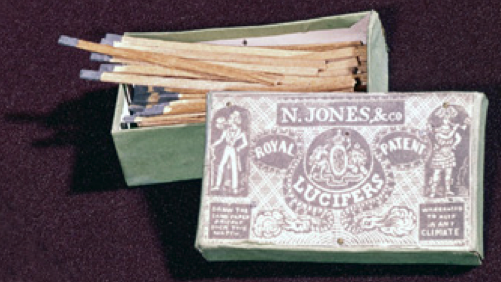
The first kind of match invented was called the lucifer match or the ‘strike-anywhere match’. Sir Isaac Holden MP claimed to be the inventor, saying that he demonstrated them in a chemistry lecture he gave in London. One of the men in the audience wrote to his father, who was a chemist, about it and ‘shortly afterward lucifer matches were issued to the world’.

Lucifer matchesThe tip contained white phosphorus, sometimes also called yellow phosphorus, which worked by a chemical reaction whenever the tip was struck and allowed it to be lit when it was struck against anything. White phosphorus, however, is highly toxic and produced a condition called phossy jaw or phosphorus necrosis of the jaw, a kind of bone cancer. In match-making factories, the people who worked as ‘mixers’, ‘dippers’, and ‘boxers’ would be exposed to vapours from the phosphorus. These fumes caused the bones in the jaw – usually the lower jaw – to start to rot. Sufferers would begin by experiencing painful toothaches, the gums would swell, and the infected bone would glow a greenish-white colour in the dark. Pus would start to form, causing tooth loss. Slowly the dead bone would separate from the living bone until the entire jaw bone had necrosed.

The only treatment was to remove the infected jaw, leaving the patient seriously impaired. If this was not done in time, the disease would spread to the brain causing serious brain damage, before causing organ failure and death.

The first case of phossy jaw was reported in Vienna in 1839 by the Austrian physician Lorinsor, who by 1844 reported 22 cases of the condition in match stick workers, establishing that the disease was caused by white phosphorus. By this time, however, the sale of lucifer matches had exploded, with women predominantly working in the factories that made them. By 1890, 60 tonnes of white phosphorus was being used in the match manufacturing industry in Britain. 50% of this was used by Bryant and May, a company established in 1843 at first to import matches but which then began to manufacture them.

Match Girls' Strike

Annie Besant’s article for The Link, 14 July 1888

Bryant and May became notorious for their treatment of their workers in 1888 when one of the most famous early instances of industrial action took place – the Match Girls’ Strike. This strike took centre-stage in the British press at the time. It started after the journalist Annie Besant wrote an article for the weekly paper The Link in July 1888 on the working conditions in match factories. In it Besant argued that the women involved in match manufacturing were dying for 4 to 13 shillings a week, with the average salary being 11 shillings and 2 pence per week, and often less due to illegal fines and deductions for materials made on their wages. Besant also noted that the workers ate their food in the same rooms that they were working in, ‘so that the fumes of the phosphorus mix with their poor meal and they eat disease as seasoning for their bread’ When the foremen noticed the swelling of the jaw that was one of the first signs of phossy jaw, she wrote, they sent the worker home and she got ‘no pay during her absence’.

The management of Bryant and May tried to get their workforce to sign a paper contradicting the facts in Besant’s article and after a group of women refused to do so the organiser of the group was dismissed, supposedly for refusing to follow the foreman’s instructions, setting off the strike. Approximately 1400 women and girls refused to work, forming the Matchgirls’ Union and approaching Annie Besant to help them make their demands. Several prominent figures, including George Bernard Shaw and William Stead, the editor of the Pall Mall Gazette, joined the campaign for better working conditions in the factory, with many advocating the boycott of Bryant and May’s lucifer matches, while other newspapers like The Times labelled Besant and the strike’s supporters as agitators and ‘pests of the modern industrialized world’.

After three weeks terms were made and the company announced that it would re-employ the sacked employee, end the fines system, introduce a system so that complaints could be taken to the managers instead of having to go through the foremen, and that food would be eaten in a separate room.

Despite the publicity caused by the strike, white phosphorus continued to be used in Bryant and May’s manufacturing of matches until 1901, and it wasn’t until 1910 that the use of white phosphorus in matches was banned in Britain.

Salvation Army matches

Advert for Salvation Army safety matches

The sad fact is that white phosphorus continued to be used for so long not because there wasn’t an alternative, but because of production costs and consumer demand. Since the 1850s Bryant and May had been importing ‘safety matches’ from Sweden, which used less toxic red phosphorus instead of white and needed to be struck against the side of the box. After 1855 Bryant and May started manufacturing them themselves, but they were not as popular and were far more expensive to produce and therefore more expensive to buy. In 1891 the Salvation Army opened its own factory producing safety matches in an effort to improve the working conditions of match manufacturers, but they continued to use child labour to box the matches to try to keep the costs down so that they could compete, and they still cost three times the price of lucifer matches, so eventually the factory had to close and was taken over by Bryant and May in 1901.

Grenfell Tower Update – Dame Judith Hackitt’s Report

Grenfell Tower Hackitt reportIt has been just over a year since the Grenfell Tower tragedy, the worst residential fire in the UK since World War 2. It has also been just over a year since, in response, Dame Judith Hackitt – former chair of the HSE – was asked to undertake an independent review of the effectiveness of building and fire regulations on high rise buildings.

Unlike the public enquiry launched at the same time, which will investigate the causes of the Grenfell fire and the type of cladding used, Hackitt’s purview was to assess the system of safety regulations regarding high rise buildings. According to Hackitt, the call for evidence that her report instigated made it clear that the current regulation system is weak and ineffective because it is confusing, inconsistent, ineffectively applied, and too easy to find ways around. 

Hackitt’s report reveals several flaws in current regulations. She discusses the fact that at the moment there are two parallel sets of regulations which come into play with regard to high rise buildings: CDM, which is focused on the safety of workers and does not apply to residents, and the building and fire safety regulations, which apply to occupants. She argues that this overly complex and impractical system needs to replaced by a much simpler version. She notes that there are currently different regulations for common parts of high rise buildings and individual residential units, and suggests that fire prevention and fire control can only be truly effective if the entire building is treated as an integrated system. She argues that there is an obvious conflict of interest in companies being permitted to pay an inspector to regulate them when these inspectors have no power of enforcement and their only recourse is to make a report to the local building control. Finally, she contends that the current sanctioning system for those who do not comply with regulations is inadequate, as prosecution cases are generally not pursued as the cost of the case tends to be higher than the penalty.

The solution, according to Hackitt, is an overhaul of the whole system, and her report makes 53 recommendations to create a simpler but more robust framework for high rise buildings. In these recommendations, she advocates for a stronger and tougher regulatory regime, with a stronger enforcement and sanctioning package so that failures to comply are met with criminal sanctions and large fines. She recommends the creation of a new regulatory body that will produce simpler, detailed guidance on how to meet regulatory standards. She advises that the current permissioning regime in Scotland, in which only buildings demonstrated to be safe are allowed to break ground and to be occupied, be enforced throughout the UK. She argues that there must be a clear duty holder at every stage of the construction process and that competence needs to be increased throughout the construction sector. Having repeatedly heard during her investigation about the difficulties residents had often faced in raising their concerns, she also emphasises the importance of empowering residents to report any dangerous occurrences and providing a clear means for them to do so.

Her report, then, suggests actions to be taken both by the government and by the construction industry. The legislation will take time, and it won’t be until early Autumn when we will know exactly how these new processes will be put in place. The changes are coming though, and they will apply to both new builds and buildings that are currently in use. Hackitt’s recommendations will, at least at first, only apply to high rise buildings with 10 floors or more, which some are suggesting is too limited. However, this already means that when the new regulations come into force 2000-3000 buildings will have to be reviewed.

Until legislation comes into force, it is suggested that construction companies should implement the suggested changes to their systems when constructing or refurbishing high rise buildings as good practice, to avoid having to do additional work later.

If you would like advice on how to adapt your building or fire safety systems to be in line with the recommendations in Hackitt’s report, contact us on 0141 244 0181 or email info@amalgamate-safety.com.

SaveSave

Beginner’s Guide to Occupational Health Services

The Benefits of Occupational Health Services to Employers

Each year in the UK approximately 137 million working days are lost due to sickness absence, costing UK businesses in the region of £16 billion per year. This averages out to about 6 days off per person per year due to sickness, but the reality is that some of these are longer-term health issues resulting in employees taking weeks or even months off work. These absences can have a significant impact on businesses, especially SMEs. Occupational Health services can help organisations by reducing sickness or injury absence, while also improving staff productivity and morale.

Amalgamate can provide Occupational Health services at your workplace, for preventative, health surveillance or treatment plan purposes. Our OH Practitioners can assess staff for Fit to Work certification, to confirm if they are able to perform standard and/or safety-critical roles. They can also monitor health issues for preventative care, including vision and hearing tests, lung function testing, blood pressure and BMI monitoring.

Where an employee has a serious or ongoing health problem, our specialist practitioners can conduct an Occupational Health Assessment. This will assist in the development of a plan to help them continue or return to work safely, and to establish any adjustments that could be made to help them to work, while protecting their health. It also offers reassurance to employers that they have a good understanding of the state of their employee’s health.

All these services can contribute to improved levels of employee wellbeing, as well as reducing absence levels and their associated costs.

Benefits to Employees

The aim of Occupational Health Services is to promote and maintain the health and well-being of employees, ensuring a positive relationship between an employee’s work and their health. This means not only coming up with preventative and health surveillance plans to try to make sure that employees’ physical and mental health is safeguarded as much as possible, but also offering additional support to employees if it is needed.

If an employee undergoes an Occupational Health Assessment, this can help their employer to better understand the problems they’re experiencing and how they affect their ability to work. Our expert advice can help remove barriers to a successful return to work or, if they’re still at work, ensure that they can continue to work safely.

Occupational Health Services can reduce the likelihood of work-related illness or injury, and can improve the experience of employees dealing with sickness absence or the return to work process.

More details of the Occupational Health Assessment process can be found here.

Getting Help with Occupational Health Services

If you’d like to learn more about the Occupational Health services we provide, call us on 0141 244 0181 or email health@amalgamate-safety.com.

Beginner’s Guide to Preventing Fire in the Workplace

A fire in the workplace is the kind of risk that many businesses put off thinking about. It is a fairly rare occurrence, but if one happens, the effects can be extremely grave and hard to recover from. Consequences could include death or severe injury, as well as loss of property, data, plant or machinery, severely impacting your organisation. The Civil Contingencies Service states that 80% of businesses that suffer a major disaster, such as fire, go out of business within 3 years.

So reducing the risk of fire to the lowest possible level is critical. There are several different elements which combine in order to do this, from assessing your workplace and checking that all fire-detecting and fire-fighting equipment is functioning, to drafting evacuation plans, and training staff in evacuation procedures and the use of fire extinguishers.

That can be a lot of work, and it requires a lot of specialist knowledge, which is why using a health and safety company, like Amalgamate, can help to put your mind at rest that you are doing everything you need to.

The Fire Risk Assessment

The first vital step to prevent fire in the workplace is to conduct a Fire Risk Assessment. This will establish where danger lurks at your property, and what specific risks are relevant to the premises. It must be conducted by a competent person and reviewed regularly to make sure that nothing is being missed.

Amalgamate have provided FRAs to a wide range of clients, including for A-listed buildings of national significance, commercial buildings, hotels, offices, leisure facilities, breweries and hospitality venues. So whatever your line of business, we’re ready to help.

We provide you with a clearly laid out report which will give you all the guidance you need to make the changes that will protect your organisation, as well as keeping you in line with all your legal obligations.

Our assessors are true experts – they’re all former fire officers, with experience and qualifications in a range of specialist subjects, including fire regulations, human behaviour in fire situations, and fire alarm systems. They have a thorough understanding of the contributory factors that allow fires to occur, and the means of preventing them.

The Fire Safety Plan

Equally important to the prevention of fire in the workplace is your Fire Safety Plan, which should consider how you can reduce the likelihood and spread of a fire, how warning will be given in the case of a fire, what equipment is, or should be, provided to fight a fire, the action that should be taken in the event of a fire, how to safely evacuate all employees, visitors, and vulnerable people, and what fire safety training staff require.

Amalgamate, with the help of our fire safety experts, can help you to develop your Fire Safety Plan.

Staff Fire Safety Training

Finally, staff training plays an often underestimated role in preventing fire in the workplace.

Companies are required by law to have enough designated Fire Wardens to cover the size of the building, its number of occupants, and the risk level of the business. Amalgamate would always recommend that you have at least two trained Fire Wardens to help ensure that holiday and sickness absence are covered.

We offer Fire Warden training courses that are delivered by highly experienced professionals, who have worked for many years in the UK Fire and Rescue services as operational firefighters and fire safety educators. This means that they have the knowledge and experience to deliver courses that are relevant, realistic, and interesting.

We run practical sessions, where the trainees head outside to take part in live fire training under controlled conditions. This gives them the opportunity to extinguish a real fire, using the same extinguishers that are used in your workplace. The instructor will work with the trainees to ensure the best, most realistic experience in a safe environment.

The more staff members you have who are well-trained in fire safety strategies – who have been shown how to use fire extinguishers (and, crucially, know when it is appropriate to try to tackle a fire themselves), who ensure that escape routes are kept unobstructed, and who know by heart the procedures to follow – can make the difference between a small incident, and a potentially tragic event.

Unfortunately, companies often have a Fire Safety Plan that sits in a folder, fulfilling legal requirements, but that staff members are unfamiliar with.

Ensuring that Fire Safety Plans are communicated to employees, fully understood, and actively integrated into working practices, requires a pro-active approach that includes regular staff training/instruction and fire drills.

How to Get Help with Preventing Fire in the Workplace

If you would like to know more about fire safety or to enquire about our range of services, call us on 0141 244 0181 or email info@amalgamate-safety.com.

Horrible Health and Safety Histories: Erethism or Mad Hatter Syndrome

When the Huguenots (Calvinist French Protestants forced to leave France after the Edict of Fontainbleu, which made Protestantism illegal in France) arrived in Britain in the late seventeenth century they brought with them a new method for making felt, and a new occupational disease – erethism, or mad hatter syndrome.

The new method involved the treating of fur from animals such as rabbits, hares and beavers with a diluted solution of mercuric nitrate. The skins were then dried in an oven before being stretched over a bar in a cutting machine. The pelts were then sliced off in thin shreds and layered onto a conical mould, where they would be pressed and shrunk with steam and hot water. The resulting felt could then be dyed and made into fine hats. The method was referred to as carroting as the mercuric nitrate solution turned white fur a reddish brown colour.

The advantage of this method was that it made the outer stiff hairs on the pelt soft and limp, and twisted and roughened them so that they matted together more easily. The problem was that the treated felt released mercury as a vapour, and felt-making tended to be done in small, confined and poorly ventilated spaces.

As a result, hatters began to present the symptoms of mercury poisoning. These included physical symptoms, such as slurred speech, headaches, weakness and tremors; and neurological problems, such as personality changes – irritability, anxiety, low self-confidence, depression, apathy, and shyness – as well as memory loss, delirium, and hallucinations.

These symptoms were known to be caused by mercury, which had long been prescribed as a cure for syphilis by being rubbed on the skin, injected or taken orally. A night with Venus, it was said, was followed by a lifetime with Mercury. However, there were no laws to regulate the use of mercury in industry, meaning that the symptoms of mercury poisoning in hatters were prevalent enough that the expression ‘mad as a hatter’ emerged in 1829, the same year a report on the syndrome was published in St Petersburg.

In 1860 a report was published in the Transactions of the Medical Society of New Jersey by J. Addison Freeman on ‘Mercurial Disease Among Hatter’s, and in 1869 the French Academy of Medicine also described the health risks associated with hat making. In France this led to a law being passed in 1898 to protect hatters, however in the United States mercury was used in hat making until 1941, despite the fact that in 1888 a new method using hydrochloride was patented.

In Britain in the 1890s, factory inspectors began taking note of any deaths and illnesses linked to working with mercury. Their evidence led, in 1899, to mercury poisoning becoming a disease that must be reported under the Factory and Workshop Act of 1895. While the aim had been to try to assess the scale of the danger from exposure to mercury for hat makers and the makers of scientific equipment, the new regulations demonstrated that mercury was used in a wide variety of industries.

In the twentieth century in Britain the problem of mercury poisoning continued to be discussed and investigated, however, little changed in terms of legislation. An article in the medical journal the Lancet in 1912 speculated that the continued use of mercury in hat making may pose a risk to the wearers of felt hats, as ‘a “hat body” may contain as much as 0.138% of mercury’. In 1919 at the International Labour Organisation conference, the question was raised as to whether the use of mercury in hat making should be banned as it had been demonstrated in France that it was not needed. However, the suggestion was not taken any further.

Since the end of the nineteenth century, however, mercury had been used less and less in hat making anyway, and ventilation had significantly improved, meaning that from the beginning of the twentieth century the number of cases reported was low enough that it was never considered a big enough problem to require specific legislation and so it simply remained monitored. From the 1940s hydrogen peroxide became used to create felt instead.

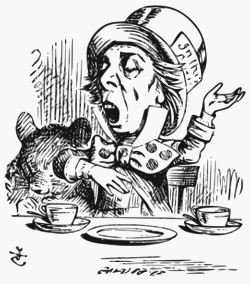
Many have argued that the Mad Hatter in Lewis Carroll’s Alice in Wonderland (1865) is meant to be suffering from mercury poisoning due to his occupation. Others have objected that the Mad Hatter does not demonstrate the shyness and difficulty socially interacting with others that characterised mad hatter syndrome, arguing that the Mad Hatter was based on the real life furniture dealer Theophilus Carter, who was often called the mad hatter due to his eccentric character and the fact that he always wore a top hat. In either case, the strong links between hat making and aberrant behaviour in the nineteenth century are evident.

These associations have been built into many later depictions of Carroll’s character. In Tim Burton’s movie adaptations of Alice in Wonderland (2010) and Through the Looking Glass (2016) the orange marks on the Mad Hatter’s skin and the orange colour of the Mad Hatter’s hair recall the symptoms associated with carroting and Johnny Depp said of his interpretation of the character that he had been ‘poisoned […] and it took effect in all of his nerves. It was coming out through his hair and through his fingernails, through his eyes’.

SaveSave

Beginner’s Guide to Occupational Health Assessments

What is the Purpose of an Occupational Health Assessment?

If you are experiencing a long-term or serious health issue, your employer may request an Occupational Health Assessment for you. The purpose of the assessment is not to add to or replace your appointments with your GP, but to help your employer to understand the problems you’re experiencing, and how they affect your ability to work. Following the assessment, we’ll give your employer expert advice on what help they can give you in order to remove barriers to your successful return to work or, if you are still at work, ensure that you can continue to work safely.

If you’re suffering from back problems, for example, we might advise that your employer conducts an assessment of your work station to consider if there are any adjustments that could be made, or if any kind of specialist equipment is required. If you’re returning from a long-term absence, we’d be able to give your employer recommendations about options such as phasing your reintroduction to work or offering flexible hours so that you can make any necessary doctor’s appointments.

What Does the Occupational Health Assessment Process Involve?

The process varies slightly in the UK and Ireland due to Irish privacy laws. In the UK, the process starts with a company sending us a referral in which they tell us why they’re referring someone for an Occupational Health Assessment. Amalgamate then contacts the employee to obtain consent to go ahead with the assessment, and arrange a time for a consultation with an Occupational Health Practitioner. This consultation can be done face-to-face or over the phone, depending on what is most suitable for the specific situation.

During the consultation, the employee is asked questions in order for the Occupational Health Practitioner to understand the background of their case. The practitioner is aiming to understand what problems the employee might be having at work, or what barriers they might be facing that are preventing them from returning to work.

Based on this consultation, the Occupational Health Practitioner writes a report that outlines the background of the case as they have had it described to them. The report includes their interpretation of the case, and their recommendations for reasonable support or adjustments that the company could make. What is discussed in the consultation is protected by doctor/patient confidentiality, so the Occupational Health Practitioner will only include in their report the personal information that the employee has said they are willing to have included.

This report is then sent to the employee to read through so that they can check that it is an accurate representation of their consultation. If, for example, something the employee said has been misunderstood, or some factual detail is wrong, the employee can request a change. In this case the Occupational Health Practitioner would look over any possible alteration and check whether this has any impact on their recommendations.

The finalised Occupational Health Assessment report is then sent to both the employer and the employee. Sometimes we might also suggest that it would be beneficial to have a follow-up consultation with the employee to check their progress or assess whether their situation has changed at all.

How do I find out more?

If you’d like any further information on our Occupational Health Assessment process, call us on 0141 244 0181 or email health@amalgamate-safety.com. For more information on our range of Occupational Health Services, visit this page.

Horrible Health and Safety Histories: Dust Explosions

Dust – a seemingly innocuous substance that makes many people sigh as they think about having to get out the feather duster. Yet as several high profile campaigns over the last couple of years – such as IOSH’s No Time to Lose campaign – have highlighted, breathing in many kinds of dust, especially those created by construction, can have serious effects on people’s health.

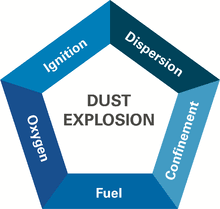
What we tend to think about less is the flammable risk associated with dust. What many people don’t realise is that many of the powders we have in our homes are extremely flammable under the right circumstances. Things like flour, coffee, sugar, cocoa, corn flour, and chilli powder have the potential to cause massive explosions if they are released into the air as a dust and then exposed to an ignition source, such as an open flame, static electricity or even a very hot surface. This is because of each dust particle’s very large surface area compared to its mass, which means that it will burn much faster and catch on fire with much less energy than when the same substance is in a pile. This means that even materials thought of as nonflammable or as slow burning can be extremely flammable in their dust form. It takes as little as 2 grams per cubic foot of air for the household powders listed above to become ignitable. 

If combustion occurs in a confined space, the pressure that builds up can cause shockwaves, doing serious structural damage to buildings, and sending objects and debris flying. These explosions can then shake up more dust, causing a second explosion.

While it is unlikely that people will be exposed to these hazards in their homes, in the factories and mills that produce these powders the dangers are very real. It is estimated that 2000 dust explosions occur in factories and refineries a year in Europe. While many of these are relatively minor, throughout history there have been many, at times disastrous, combustible dust explosions.

The first recorded dust explosion was in 1785 in Turin, when flour dust in Giacomelli’s Bakery Warehouse came into contact with a lamp, injuring two employees. Throughout the nineteenth century there were many dust explosions throughout Europe and the United States, several of which completely destroyed the mills they took place in. The most notable was in 1878 in Minnesota, when a buildup of flour in a mill caused an explosion that killed 18 people. The blast was so powerful that limestone blocks were sent flying, and windows in neighbouring towns were broken. 

dust explosionIn the early twentieth century, in 1916, a dust explosion at the Quaker Oats Cereal Factory in Petersborough, Ontario killed 23 of the factory’s workers and destroyed the entire building. An explosion of a silo storing 4500 tons of a mixture of ammonium sulphate and ammonium nitrate fertiliser in Germany in 1921 is estimated to have killed between 500 and 600 people and injured 2000 more.

The worst flour mill explosion on record occurred in Westwego, Louisiana in 1977, when a buildup of grain dust came in contact with static electricity. The explosion caused 49 silos to catch fire, killing 36 workers, many from being crushed by the collapsing silos. Building code reforms for grain silos were based off this event.

In 1981, there was a dust explosion at the Bird’s Custard Factory in Banbury. A hopper – a container used to hold particles that have been collected from expelled air – became overfilled, creating a dust cloud of corn flour that ignited due to nearby electrical equipment. The explosion blew the roof off the building and 9 workers were injured. As custard is made when heat and water are added to custard powder, the water from the fire engines that came to put the fire out created gallons of custard inside the building, which then came pouring out.

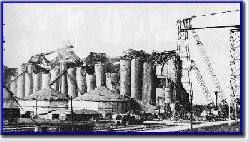
More recently, in 2008, there was a dust explosion at the Imperial Sugar Refinery in Georgia that killed 13 workers, hospitalising 40 more. The main damage was caused by a second explosion as sugar stirred up by the first explosion ignited, demonstrating the importance of proper housekeeping.

Dust explosions

Imperial Sugar Refinery, Georgia

All dust explosions are preventable. Under the Dangerous Substances and Explosive Atmospheres Regulations 2002 (DSEAR) companies are required to:

  • Identify what dangerous substances there are in their workplace and what the fire and explosion risks are;
  • Put control measures in place to either remove those risks or, where this is not possible, control them;
  • Put controls in place to reduce the effects of an incident involving dangerous substances;
  • Prepare plans and procedures to deal with accidents, incidents and emergencies involving dangerous substances; and
  • Identify and classify areas of the workplace where explosive atmospheres may occur, and avoid ignition sources in those areas.

In a workplace containing potentially flammable atmospheres, employers must make sure that any explosion safety measures are confirmed as being safe by an expert in the field of explosion protection. 

Unfortunately, when dust explosions happen it is often due to poor maintenance, deficient housekeeping, inadequate inspection regimes, or because something has been missed in a risk assessment. In all of these situations Amalgamate can help, whether it is by doing hazard identification exercises and hazardous operations reviews to make sure that all potential hazards have been considered and that adequate controls are in place, or by carrying out regular systems audits and site inspections. 

Contact us on 0141 244 0181 or visit our consultancy page.

Sun Safety for the Summer

Most of us are probably pretty delighted with the current heatwave. It makes a lovely change from the usual rainy UK summer! But if there’s one thing British people are famous for, it’s getting over-excited at the sight of the sun. You know the drill – at the first sight of a bright blue sky, the men are getting their shirts off, everyone heads to a park, beer garden, or outdoor cafe, and pretty soon the streets are filled with sweaty sunburned faces. The fact is, when it comes to sun safety, we’re just not as savvy as our European counterparts. The novelty value of seeing real live sunshine at home overcomes our logic, and then our body suffers.

So what are the risks, and what should we be doing differently?

By now we should all be aware of the risks of skin cancer. But still, every year in the UK, more than 100,000 new cases of skin cancer are diagnosed, and over 2,100 people die. So sunscreen is a must if you’re going to be outside in the sun. You should be using at least factor 15, and a lotion that protects against UVA and UVB.

Something that is often disregarded is how important it is to ensure that you’re using enough lotion. To cover your face, neck and arms, you should use around 2 teaspoons worth. For a full body, it should be about 2 tablespoons. And if you’re outside for an extended period of time you need to re-apply it frequently too. Covering up with loose fitting clothing and a hat is a great idea, as is making sure you get in the shade for at least part of the hottest time of day, from 11-3.

In high temperatures, especially if you’re not used to them, it’s easy to get dehydrated. And there’s also the risk of heatstroke – which is deeply unpleasant. If your body starts to overheat it can cause headaches and vomiting, and in severe cases delirium, seizures or loss of consciousness. To reduce the risks of sunstroke/heatstroke, spending time out of the sun will help, as will making sure you’re drinking enough water. So make sure you’re getting those recommended 8 glasses a day when things heat up.

Sun Safety for Outdoor Workers

Sun safety is particularly important for people who spend a lot of time outdoors. This includes road and construction workers, delivery staff and gardeners, among many others. UV radiation is classed as an occupational hazard for outdoor workers. This means that their employers must include sun protection advice in their health and safety training.

Depending on the type of work environment, there are various steps they could take, like encouraging staff to use adequate sun protection, wear a hat, and take breaks in the shade. They could also consider scheduling work to reduce sun exposure, and provide rest areas and water points that are shaded. As always, consulting employees and safety representatives is a good way of keeping people involved in health and safety, and getting new ideas.

Staying safe in the sun is pretty straightforward, you just need to get into some good habits. We hope you take the time to put these steps into action and protect yourself, and any employees you are responsible for. Now go enjoy the summer!

We offer a range of services that include guidance on all your H&S responsibilities as an employer. For more information, contact info@amalgamate-safety.com or call 0141 244 0181.